
Endurance just ran 1,671 kilometres. With 62% of the battery to spare.
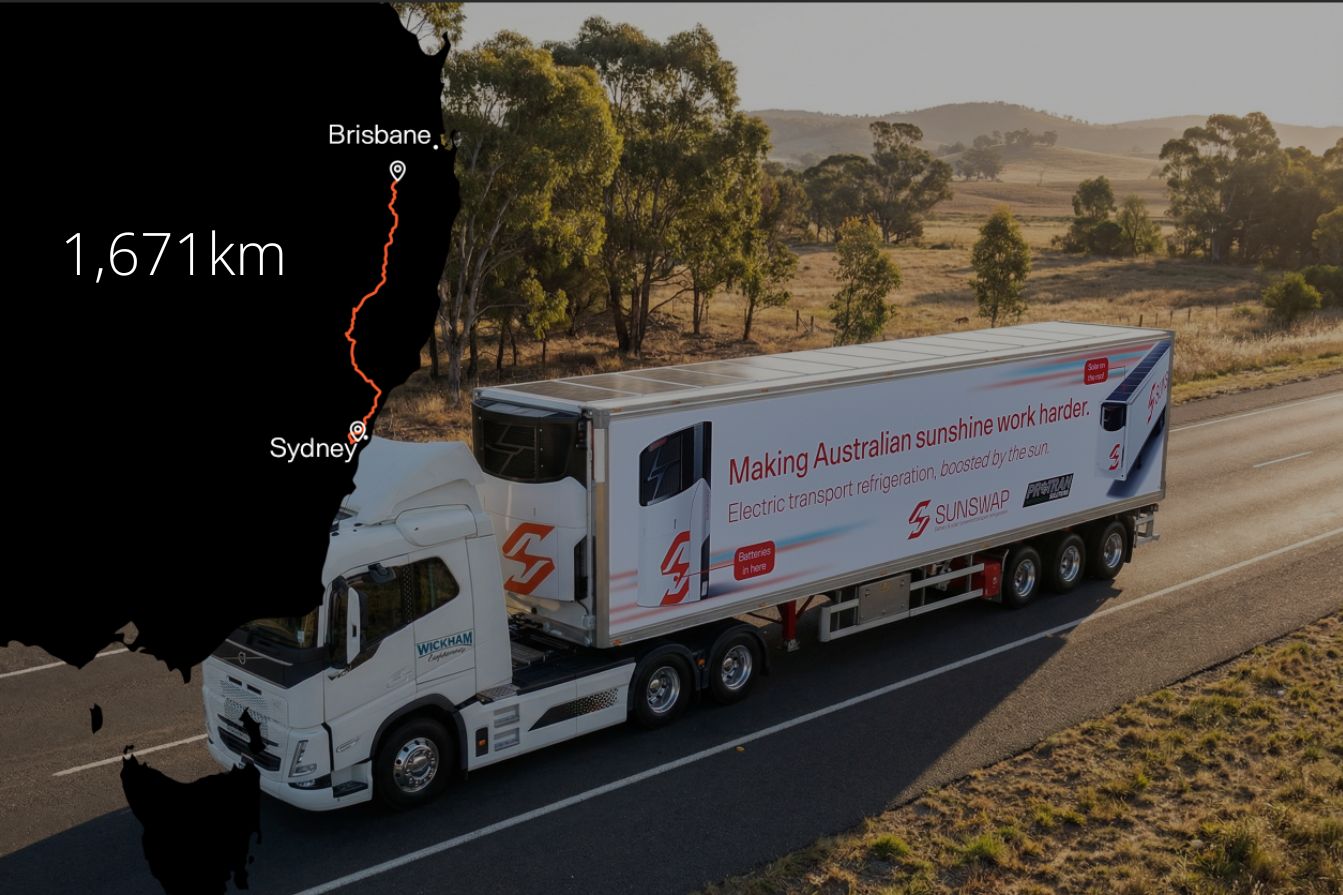
Sydney to Brisbane and back. Frozen meat and chilled eggs running simultaneously. 32 hours of continuous operation, including seven hours overnight with zero solar input.
Endurance finished the run with 62% battery capacity remaining.
Protran Solutions, Sunswap's Australian distribution partner, operated the route for an operator as a real-world validation of what Endurance can do across the distances Australian logistics actually demands. No plug-in charging at any point. No connection to the truck's power systems. Battery and solar only, across one of the continent's most demanding commercial corridors.
Grant Turner, General Manager at Protran Solutions: "The Sunswap Endurance system has proven it can handle the Sydney-Brisbane return route while maintaining precise temperature control for frozen and chilled freight types, all without consuming a single drop of diesel for refrigeration."
What this means beyond Australia
The Sydney-Brisbane run is a great data point. What it demonstrates is a principle: Endurance is built to work in conditions that would previously have made electric refrigeration feel like a risk.
Australia wasn't chosen because the conditions are easy. Routes regularly exceed 1,000 kilometres. Overnight operations are standard. The infrastructure assumptions that underpin European logistics - depot charging, short routes, predictable daily cycles - don't apply. Endurance ran on that basis and had more than half its battery in reserve when it finished.
Sunswap now operates commercially in the UK, the Netherlands, France, Chile, and Australia. This is the same system in every country with the same performance standard across all of them. You can read more about how Sunswap is expanding across Europe and beyond.
The question every operator asks about electric refrigeration
What happens in winter? What happens when generation is low?
Operational data from UK and European fleets through November 2025 to February 2026 answers it directly. When ambient temperatures drop, so does cooling demand. Lower generation in winter months is offset by a lower load on the system. The two move together. December 2025 fleet data shows solar contributing around a quarter of total energy through the lowest generation months - not because conditions were favourable, but because the system accounts for them.
DFDS introduced Endurance in November 2024 and ran frozen goods through the full UK winter. They presented the results at the Cold Chain Federation Climate Summit. The units exceeded expectations.
In January 2026, Store Logs ran 30 hours of continuous cooling at -22°C - South Kirkby to South Wales, no plug-in required. Their Group Logistics Director, Mark Coventry: "One of the best trials we've ever had as a company." That same month, Prevote in France ran Endurance on their hardest routes delivering for Carrefour - 21 hours at -20°C. Derry Group in Northern Ireland ran multi-temperature operations through January, frozen at -21°C alongside chilled at +3°C, twenty stops per day, six days a week.
In Chile, where annual solar irradiance runs significantly higher than northern Europe, the economic case shifts further still. In Australia, where the distances remove any margin for error, the battery reserve holds.
Fundamentally, Endurance was built to perform - a more efficient refrigeration system designed around the real-world routes operators run every day. See how Endurance works and explore what operators have achieved running it.
If you're evaluating electric refrigeration for your fleet and want to work through what the operational data looks like on your specific routes, get in touch.
Noticias y actualizaciones
Mantente al día con las últimas novedades de Sunswap.