
Summer isn't the hard season for Sunswap Endurance. It's the best one.
Your diesel fridge hates summer. Higher fuel usage and increased breakdowns, with the load melting the back.
Meanwhile, in the southern hemisphere summer, Sunswap Endurance generated more than three times as much energy from solar as it drew from the grid.
Then on a single run with Walmart covering over 500km, the unit completed 26 hours of cooling and arrived with 76% battery remaining.
That number - three times more solar than grid - is the answer to the concern about Sunswap Endurance in the summer. The assumption behind "will it cope in the heat?" is that high ambient temperatures put the refrigeration system under pressure. The logic is correct: more heat means more cooling demand means more energy drawn from the battery. What it misses is the other half of the equation.
Summer is when Endurance works hardest, and when it's powered most cheaply
Powering Endurance from battery and solar creates a natural counterbalance. Higher ambient temperatures means solar output is up at exactly the same time your cooling demand goes up.
On most routes in summer conditions, those two forces can cancel each other out. In Chile, the sun was generating energy faster than the routes were consuming during daylight hours.
Those same dynamic plays out wherever Endurance runs in warm conditions. In the Australian summer, Endurance ran from Sydney to Brisbane and back - 1,671km across 32 hours of frozen and chilled operations simultaneously - and used 28% of the battery across the entire run with no external power at any point.
In the middle of a UK summer, Staples Vegetables drew 96% of its power from solar - including routes carrying warm incoming cargo straight from the fields, with peak cooling demand throughout. Operating costs were significantly lower than diesel.
Built to perform. Even in the heat.
The reason operators don't come back with summer performance problems is part design, and partly the work done before the unit ever goes on the road. Sunswap Analytics models a decade of local weather data against your exact delivery cycles - temperature peaks, route distance, door openings - and allows us to ensure you have the right size hardware specs for your routes. By the time Endurance is running your routes, the hottest days of the year are already accounted for.
It holds temperature too
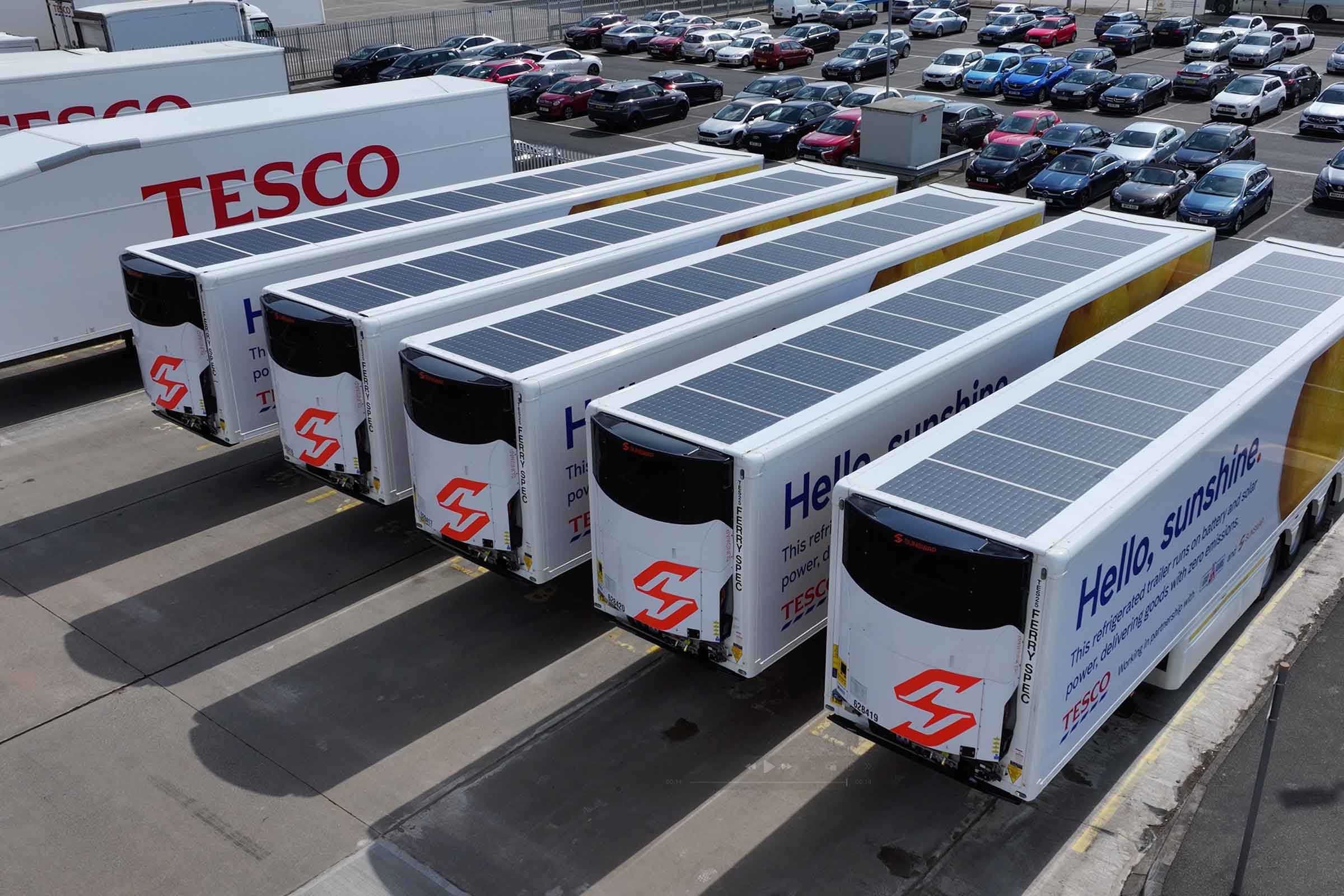
Higher door-opening frequency and greater thermal load are the real test of a refrigeration unit on a hot day. Ocado runs Endurance across their double-deck trailer fleet - the most demanding configuration in commercial use - in daily operation. When Lineage Logistics evaluated every competing system on the market against routes running 12 hours or more with frequent door openings, they rated Endurance the only unit capable of meeting them.
Tesco, Ocado, Walmart, DFDS, Birds Eye
Across three continents, in UK winters and southern hemisphere summers, on frozen routes and chilled, double-deck and standard - Endurance runs in daily commercial operation with the operators above and others. The summer concern has been tested at scale, across climates, by operators with no tolerance for performance that doesn't match diesel.
None of them went back.
Curious about your routes? Sunswap can run a simulation for your hottest days and longest runs.
FAQ
Does heat reduce the battery range? Higher ambient temperatures increase the cooling load, which draws more energy. But warmer days have much higher solar generation. This creates a natural balance. On most chilled routes in summer conditions the two largely offset each other - and in some cases, as operators in Chile and the UK have both demonstrated, solar output exceeds demand entirely.
What if it's overcast, or nighttime whilst hot? The battery handles the route without solar contribution if needed. Solar extends range and reduces charging costs; it isn't the primary power source. Endurance runs from battery first, with solar topping it up continuously wherever daylight is available. Both runs cited above in Australia and Chile include operation throughout the evening and night.
Can it really run for days without charging? On chilled routes with meaningful solar availability, yes. Muller ran two weeks without plugging in, and the unit can run up to a month without charging. On frozen routes the battery handles more of the load, and charging during natural depot downtime - loading, unloading, overnight - is typically sufficient.
Is it spec'd for our specific conditions? Every deployment goes through route simulation using Sunswap Analytics, which models 10 years of local weather data including ambient temperature peaks. A unit deployed in southern France would be specified for those conditions.
Does it work on frozen routes in summer? Yes. Frozen requires significantly more energy than chilled and the battery is sized accordingly. Wickham Freight covered 1,671km across frozen and chilled simultaneously with 28% battery remaining. Frozen performance in high ambient conditions is a function of correct specification for the route.
Noticias y actualizaciones
Mantente al día con las últimas novedades de Sunswap.